Tuesday, March 29, 2011

Rubber Boots, Vocab, and lots of Parenthetical Explanations

It's "breakup" in Homer, Alaska. 'Breakup' is what the rest of the English-speaking world calls 'spring,' but Alaskans like to have code words for everything, presumably to tell who has been here a while, and who hasn't survived a winter yet. For example: Trucks are called "rigs," newcomers are called "cheechakos," and everywhere besides Alaska is called "outside." (That last one gets confusing if you are indoors and start talking about 'going outside'.)
But, back to breakup: The basic explanation behind this term refers to when the weather gets warm enough to thaw lakes and rivers and the ice "breaks up," something that in ye olde days (in Alaska, that's 50 years ago) was really a herald of spring for those living in the 'bush' (term Alaskans use for wilderness way far away from roads, supply stores, or a cineplex showing the latest Harry Potter film) who relied on waterways for their supplies, and the first boat of Spring was much anticipated. Now, a lot of bush communities rely on airplanes to get most of their stuff, and thus have all the Mountain Dew and Cheez-Its they want throughout the winter. But, we keep using the term 'breakup', and we even bet on when certain bodies of water will defrost, most notably, in Nenana, where the Annual Ice Classic has a tome of rules and pays out a big cash prize.
In my life, 'breakup' means a lot of things, but most emphatically, and without exception, it means that I should be wearing rubber boots (referred to as "breakup boots" in some parts of Alaska, but in brand-conscious Homer, only "Xtra Tufs" are acceptable), even when it seems like overkill.
I haven't been here very long, and sometimes I try to get around this rule in the name of fashion, comfort, or practicality. It only shows my cheechako-ness. There are occasions during breakup where I decide not to wear rubber boots, for example, during my morning jog: Then I slip on a patch of ice and go skidding off the bike path into the sludge filled ditch. Should have been wearing rubber boots.
Or, a trip to the gas station to fill your car with $4.17/gallon gas: My car is inevitably caked with springtime mud, and I will decide to use the window squeegee to try and get a free car wash while the pump runs. The water from the squeegee will collect all the mud in its path and then ooze off the car onto my leather fashion boots. Should have been wearing rubber boots.
Or, your friends throw a dress-up party, and invite you to play kickball (this dichotomy is already an advanced wardrobe quandary, without introducing a weather element): Kickball seems like a sneakers event. Their yard is half snow and half mud. Even though you are wearing a festive party dress, your only reasonable footwear choice should be rubber boots.

The trickiest footwear decision was for the annual Sea to Ski Triathlon. I did the ski portion of the event for my team, "Vitamin B3".  In most springtime triathlons around the country, the races go downhill. In Homer, we have more than our share of competitive athletes, and I think this is the reason that our whole race goes straight up the bluff. Breakup has been warm this year, and the snow on the ski trails is already fading away. Thus, the last 100 yards of the trail were down to bare road. Instead of ending the race 100 yards sooner, on the snowpack, the ultra-competitives in Homer decided racers would take off their skis and run for the finish. It makes sense that I was wearing my ski boots at the end of the 5 km ski, but sliding along the muddy road to the finish line, I realized that breakup got me again: I should have been wearing rubber boots.

Friday, March 25, 2011

Returning... "with the grace of a cartwheeling cow"

Half of me was excited to come home. That half of me now wishes I was back in Bolivia.

The first news I got after de-boarding the plane to Homer was that there is a dead moose in the outfield of the softball field. A meeting is being held to figure out how to move it. Everyone in a small Alaska town has an opinion on how to best remove a dead moose from a softball field, and these are the things that are mentioned: chainsaws, four-wheelers, big trucks, large metal hooks, ice chippers, dragging, throwing, flinging, and, of course, "I'm not playing outfield this year!"

I left the moose to the softball commissioner, because I have a bigger problem. Specifically, my airplane was supposed to be through it's regular scheduled maintenance by the time I got home. If you think it had even begun, you are as much of an optimist as I am. I went down to the hangar where I had parked the plane last fall, and found that there was 3 inches of ice covered by a slick layer of water on the floor of the hangar. That's right. There was ice indoors. The three wheels of my plane were frozen into the ice. Since the ice chipper was busy on the softball field, we slipped and slid around the hangar, lashed the plane to a pickup truck and dragged it outside.

The reunion of Beryl and I, fresh out of the hangar
Once freed from her icy tomb, Beryl started right up, and she and I went for a couple laps around the field. Both she and I remembered how to fly, to our mutual relief. It felt good to once again have the throttle in my hand and watch Kachemak Bay sink below me.

After one day of work, I made a plan to meet some friends for a beer. In this small town, I know close to everyone, and had anticipated that it would be fun to go out and say 'hellos' to folks I hadn't seen all winter. This went as planned, until my ex-boyfriend's firefighter buddies sat down at the next table and announced to me, and the whole bar, how much better my ex is with his new girlfriend than he ever was with me. Oh, and welcome home. 

The only way airplane maintenance would move forward was apparently if I put some time into it. It's not that I am not willing to wrench on my own airplane, it's just that I have 1001 other things to do, having just returned home. But, the expensive piece of flying metal takes priority, and with some borrowed tools, I took to removing the exhaust. I was surprised at my own efficiency at this task, except for the fact that I cut myself on something, and bled all over the white cowling. I'm certain that blood all over the hood of the aircraft doesn't instill passenger confidence.

The silver lining of being back in this beautiful town on the Bay is that there is always something to do. I'm already enlisted for a ski race this weekend, and I decided to treat myself to those new skis that are on sale for spring. The guy at the ski shop (it should be noted that, in Homer, the ski shop is also the hardware store, the pharmacy, the quilt shop, the pet store and the Hallmark Cards) invited me into the back room where he mounts bindings and waxes skis. He told me about how many and what types of skis he had sold this winter, and then gave me a bonus gift: his other hobby, besides talking skis, is tying fly-fishing flies. So, with my brand new cross-country skis, I got two flies hand-tied with polar bear fur. I have next to no use for these, especially in conjunction with my skis, but the gesture made up for the boys at the bar being jerks, and maybe even made the cuts on my mechanics' hands heal a little faster. I guess I'll give Homer another week before I buy a ticket back to Cochabamba.

Sunday, March 20, 2011

Bolivia: I miss you already.

I'm headed home. In 3 days and 5 flights, I'll be back to so-called "real life." The Bolivian guard that was responsible for my drug search at the La Paz airport was really interested in how much I liked his country. I'm keeping my fingers crossed that I get as much as a "welcome home" from my own border guards. 
I can't sum it all up, but here are some quotes and pics that capture people and moments that made up the last few months of my life...

 "Nada es puntual in Bolivia, pero todo es posible." -Diego


What you get when you order coffee in Bolivia... Kbay, here I come!


"You are the least flexible person in South America." -Chris (to salesguy when negotiating unsuccessfully for a different price)

"Everything will be possible in 10 minutes." -Cameron

Salaar de Uyuni


"You can't have too many men in your basket." -Raphy


So, the Incas were so advanced that they could market urine?

"I am no longer confident in farting." -Josh

I'm headed for a land where toilets take on more responsibilities


"Remember: the birds, the butterflies, and the views all want you to die." -Leith


I've thought this through, and this country has made me a better person. I'm not sure how, but I can feel it... and it's not just indigestion or altitude sickness, because this country has taught me to recognize those things as well. 


Friday, March 18, 2011

The Death Road

Everyone guaranteed me that Bolivia was very dangerous, but after two months unscathed and time running out, I thought I had better try harder. The travelers on the backpacker circuit convinced me to sign up for the World's Most Dangerous Road (a.k.a. "The Death Road").  Apparently, somebody in the world keeps track of which public roads have the most deaths per kilometer, and the "highway" from La Paz to Coroico wins. Instead of closing it or putting up guardrails, they have made it into Bolivia's most expensive tourist atttraction. The road is 63 kilometers of shear cliffs and waterfalls (Yes, waterfalls: falling right on the road.), built in the 1930s by Paraguayan prisoners of war. It is mostly downhill, so not a hard ride, as long as you don't go over the edge.


The ride starts at a 4700m (15,400ft) pass, and one girl in our group fainted from the altitude while getting the safety briefing. She dominoed the whole row of bikes, so everyone was off their feet before we even started downhill.

Early in the ride, there is a stretch of 8 kilometers uphill. The bike company gives you the option to throw your bike on the van and ride to the next downhill stretch. I asked myself, "What would Homer Womens Nordic (my cross country ski team) do?", and started sucking 4000meters worth of oxygen as I pedaled. All the rest of the girls in our group jumped in the van, and a German boy looked at me doubtfully and said, "If you get tired, you can just get in the van." This snide comment changed the question to: "What would Megan Spurkland (fierce coach of HWN) do?" Thus forced to beat all the boys to the end of the uphill section, I'm pretty sure I permanently damaged my lungs.

A lot of the road was in fog when we rode it, so the dramatic drop offs were obscured, but it is obvious that there really isn't adequate space for large vehicles between the mountain and the cliff.  The ride is a lot of fun on a bike, but you really would have to be a muppet to stear a small, man powered vehicle over the edge.

Descending from high Altiplano with snow covered mountains into rainforest was spectacular (I'm making a judgment call that this was a 'rainforest' as it was a forest, and it was raining when I was there).

At the bottom, we visited La Senta Verde, an animal refuge that rescues illegally captured exotic animals from captivity and interns them at their refuge. I don't really see the point of moving the animals from one cage to another, but this is marketed as a pretty 'green' locale.

Track torn by a drunk taxi driver going over the edge
We drove the van back up the death road (instead of taking the new highway that was opened in 2006) and got a great idea of exactly how unsafe this thoroughfare is. In some spaces, there is no gravel between the tires of the van and the edge of the cliff.  Our guide told us about every crash site as we passed, the largest single incident resulting in over 100 people dead. Why vehicles still use the road was never fully explained (don't ask 'why' in Bolivia), but by far the biggest traffic source is a parade of gringos in bright orange safety vests... better to see them as they tumble down through the trees.


Wednesday, March 16, 2011

Lost on an Island... isn't there a TV show about this?

From the La Paz airport in El Alto, I set out to find a bus to Lake Titicaca. Everyone has told me that you have to see the world's highest navigable lake (though no one can define 'navigable') and Isla del Sol, where the Incan creation myth is born.

You would think that I have been in Bolivia long enough to know that asking a cab to take me to the 'bus terminal' probably won't work. Here, they don't always see the use for having a terminal building per se. Sometimes, the buses just park on the street and guys stand next to them yelling destinations. My taxi dropped me off on a street with a lot of buses and a lot of yellers. This system doesn't always leave room for all the buses in one location, and I quickly realized that no one was yelling "Copacabana!", the place I was trying to go. So I got into another cab and found another street of buses. Bus ticket to Copacabana: 15Bs. Cabs to get from airport to the bus: 32Bs.

The journey to Copacabana, the gringo hub on the shores of Lake Titicaca, is a few hours and the bus has to cross some water of the lake between peninsulas. They are talking about a bridge, but for now, they put the bus on a barge, and then they make all the passengers get out and buy a ticket on a boat so they can catch up with their bus. One of the bus barges was named 'Titanic'. Not comforting. I took my gear on the boat with me, rather than leaving it on the bus.

Copacabana was still having Carnaval when I arrived. This is the holiday that never ends. A little boy chased me around town with a can of spray foam. I tried to see some Incan ruins, but the gate was locked. I talked to the other travelers at my hostel, all of whom are on whirlwind tours and I quickly tired of the "where have you been?/where are you going next?" conversations.

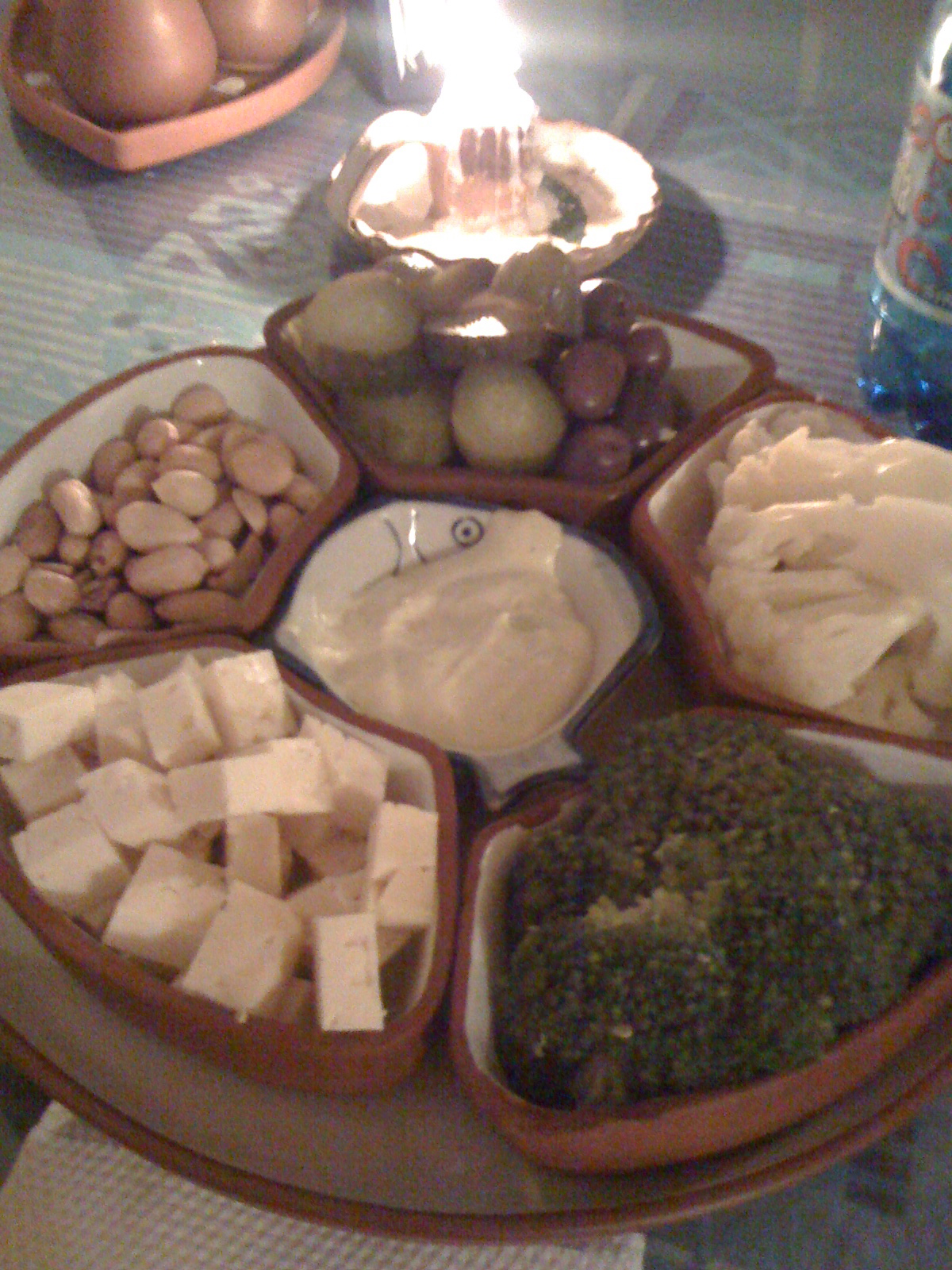
I was still sad from leaving Cochabamba and decided to treat myself to a nice dinner. I sat down in an appropriate feeling restaurant, poured over the menu, and then decided that I deserved the "House Speciality." When it arrived, it was a cold plate of bland cheese, unsalted peanuts, broccoli and olives with ranch dressing.

Still hungry the next morning, I went into one of the many cafes serving breakfast to backpackers and was excited to see "Müsli" painted on two signs by the door, as cereals are very uncommon in Bolivia. The table I sat down at was covered with crumbs and had a dirty spoon left from the last customers. The doña brought me coffee, and it was on a filthy saucer in a dirty cup. Of course, it's Nescafe. She picked up the dirty leftover spoon from across the table and set it on my saucer.  I began spinning the cup around to look for the least dirty side to drink from. I was given a piece of bread and had to clarify my "müsli" order. She apologized. Imagine how excited I when she came back from the kitchen and served me popcorn with yogurt on top.

I got on the boat to Isla del Sol and enjoyed an hour and a half scenic cruise to the island. When we got to the dock, a woman asked me for a 5B tax. I had 3.50B or 100B. The woman denied having change, even though I was the 60th person in line paying this tax. I offered to pay 3.50B. She refused and said I needed to pay 5B. I puzzled over this problem for about 2 seconds and then asked, in Spanish, if I could just pass without paying. She said fine. 'Don't ask 'why' in Bolivia.'

Isla del Sol is a beautiful mountainous island sticking out of Lake Titicaca at about 4000m above sea level (13,125ft). Some 10,000 people live on it and they all seem to be running hostals and pizza restaurants in varying degrees of mud or brick buildings. I wandered up an Incan staircase and set out to find a place to stay for the night. After an hour of aimlessly pondering which direction to go, I ran into a guy from New Zealand, who was also lost. He denies that we were lost, but I found him sitting hopelessly on a stoop asking an equally bewildered me for directions. Consulting donkey-herding locals, we made our way around a mountain, climbed through fields, and puffed over ridges. We finally (accidentally) stumbled on the hostel we were looking for, nowhere near where the Lonely Planet map said it was.

After finding a place to stay, and celebrating with a beer, we realized we had pretty much done everything Isla del Sol has to offer, and that is: wander around.

The next morning, we got a cereal-free breakfast and hiked to some Incan ruins in the south part of the island. A woman with a pad that could be purchased in any shop wrote us a "ticket" and charged us a 5B entry. The ruins were small and I asked this ticket "official" if she knew any information about them. She said she did, but she had forgotten it.

The boat back to Copacabana was just as scenic as the ride there, with just as many backpackers to chat with about all they had seen on the "gringo trail" around South America. I like lakes, but I'm not sure how this pretty island attracts quite so many visitors. But who can pass up visiting the place that the sun was supposedly born?

Monday, March 14, 2011

Wrapping things up and moving on

Cochabamba was hard to leave. But good things are, I guess. The definite highlight of my time there was my host family, and knowing they can't get visas to travel to the States and having no certain plans of returning to Bolivia made the 'goodbyes' really sting. My other time in Cocha was spent with the other international volunteers I met at Sustainable Bolivia, and then I managed to squeeze in some time actually volunteering.
It really surprised me how difficult it is to volunteer. One would think that anyone could work anywhere for free, and one would be wrong. It took a lot of Internet research and following through on various recommendations of friends to find opportunities. Then it took barrages of emails, many of which were never replied to. Finally getting linked up with Mano a Mano was a blessing, but a lot of what could have been useful time was wasted.
I spent most of my time working on a school in Apote. I have moved a lot of rocks and bricks and feel that this is going to be great for my homerun-hitting stats this summer. We almost finished the first floor by the time I left, and it was cool to see the progress.
After wasting time finding a project to work on, the obstacles were compounded by things like the transport strike and then by holidays. There were weeks where I could never get to the building site. With this time, I helped Mano a Mano with some translation work, which even someone with my Spanish can do, thanks to Google Translate.
One day during the strike, I went to Solomon Klein Orphanage at the suggestion of friends. When I stepped in the door, they asked if I could help and I was put in a room with twenty 3-year-olds and one other adult. One little boy was blind, one had a club foot, one girl was dangerously skinny. All of them were only as clean as a few adults can keep that many filth-loving munchkins.  I only lasted the morning. It was good to be there, as there was clearly a need, but I just kept thinking 'but for the grace of God...' It made me so sad to think that these kids deserve to grow up with as much love as I did, and they won't have that chance. Then it challenged my belief that 'God's love is sufficient,' a belief that should be and is always challenged, but when looking at those kids, was very hard to wrestle out. I feel like a coward for not spending more time with those children. It was something I did not have the strength to do.
This 'volunteering' thing is like using your fingers to stop leaks in a dam. The dam is never gonna be repaired, or even hold, but you can't pull your fingers out once you're personally and physically committed. 

Luckily, my escape from town, after tears shed saying days of 'goodbyes,' was more graceful and fun than I deserve.  On Aerosur, one of Bolivia's airlines, pilots can jumpseat for free. That means if a flight is not sold out, you can just roll up to the airport with your pilot's license (private or greater) and they hand-write something on a piece of paper to get you through security and you board the plane.
This is how I got to La Paz. When I got on the plane, in my jeans and Chuck Taylors, the flight attendant asked if I would rather sit in the cockpit or in First Class? Since the USA thinks that fighting terrorism means abolishing professional courtesies, I am not allowed to ride in the cockpit of airplanes in my own country. I have never been in the cockpit of a Boeing aircraft in flight, and this one was headed to the world's highest airport. Easy choice. I sat between the pilots and chatted with them as we flew over the snow-capped Andes.
Cochabamba to La Paz is just over 150 nautical miles. In the bus it's 7 hours. In a 737, it's 30 minutes. 
I was mentally fighting between drinking in the views, studying the cockpit, and just thinking: "I can't believe I can do this!" What have I ever done in my life to deserve sitting in the cockpit of an airplane for free, chatting in a foreign language about my profession, and seeing views of Andean glaciers and Lake Titicaca, while studying high-altitude flight characteristics?  I may never solve or even understand the world's problems, but one thing is certain: my life is a lot cooler than the cheap sunglasses I buy.

Saturday, March 12, 2011

Would you rather stand in front of a crowd in your underwear or...

At the end of the past week, Mano a Mano invited me to join them in helping open a clinic they had just finished building in Aramasí. Don't feel bad that you don't know where that is. No one does. I think that's kind of the point. Suffice it to say, that Aramasí is about an hours drive from Cochabamba, and one of the most pathetically ugly villages I have ever seen. It sits in the center of an extremely flat valley and is just a very large collection of small mud huts. Approximately 10,000 people call this paradise home, and I hope all of them like brown, because that is the prevailing color.
On Thursday, we took a large crew to Aramasí to outfit the newly constructed clinic. After Mano a Mano builds a clinic, they bring all the supplies to get it up and running. We set up everything, including the staff housing, so that the final product is a turn-key operation for the receiving village. Then, on Friday, an inauguration was scheduled, in order to have a Grand Opening of the new clinic and turn over control to the village and their leadership.
Of course, Friday, after working through Carnaval and few extra days for good measure, the transportistas went back on strike. Large blockades were set up at all the entrances to the city and no public transport was running. I think the strikers got a little lazy over the holiday, as some of the found objects from which the blockades were constructed bordered on ridiculous this time: small branches, leaves, dirt and coconuts don't strike me as the most efficient way to stop traffic.
However, Mano a Mano has a four wheel drive vehicle and is not to be deterred from their mission so easily. We found back roads and tracks out of the city, and Dr. Velásquez, Mano a Mano's director/blockade-runner driver, fittingly drove like he was being chased by an naval warships.
We bounced into town just slightly behind schedule and about 300 meters from the clinic came across a bike accident. A boy had somehow fallen and gotten his leg wedged in between the spokes and frame of his bike. He couldn't get free and his foot was bent at a very unnatural angle. We jumped out of the 4WD and went to help. Dr. Velásquez used a tool kit to disassemble the bike frame and free the boys foot... basically a "jaws of life" operation, but quieter. After deciding the boy would still be able to walk, he was advised that there was a brand new clinic just down the road, and we headed that way.
The inauguration ceremony was very well attended. Hundreds of villagers were there and hundreds of students from the school arrived in a parade carrying flags. The clinic was festively decorated and huge speakers were set up. Multiple Mano a Mano directors joined the mayor of the village, the doctor for the clinic, and other local officials. Everyone took turns giving speeches and loud music was played.
I was tasked with photographing the event, so imagine my surprise when someone announced into the microphone that "Our volunteer from Alaska will now come forward and read the dedication plaque!" I think that was the last Spanish I clearly understood. My peripheral vision went white and my knees went weak. I politely tried to beg off. I am functionally illiterate in Spanish. From a distance as if thru water, I heard the man with the microphone offer that I could 'read in English if I wanted.' Since the plaque was in Spanish, that meant adding translation work to the horror in front of me.
Not wanting to be rude and not seeing a hole to fall into, I took the microphone, looked at the group of almost 1000 Bolivians gathered in the sun in front of me, and began to read,  croaking out pieces of words in Spanish. I stumbled over syllables and paused at least once in the middle of every word. But that's not the bad part. Do you have any idea how many numbers are on a dedication plaque? The plaque was between 15 and 20 lines and at least every third line had a multiple digit number: my Achilles heal! I almost cried every time I came to a number I couldn't pronounce. I stupendously finished by reading the date: "Marzo de..." and having no idea how to say "2011". Someone finally whispered "dos mil once" and got me out of the spotlight just as I was thinking I would rather be standing in front of all these Cholitas (traditional Bolivian women that dress in big skirts, hats and wear braids) in my underwear.
After all the speeches were finished, it seemed that half the village wanted to say 'thank you' and I learned that in Aramasí, you shake hands, kiss on both cheeks, and then shake hands again. This is cumbersome in a crowd of well wishers. Eventually we were escorted to the market and were fed a ridiculously large 'thank you' meal. Everyone was staring at me for the rest of the day, and I figured they were all thinking: "there's that stupid gringa that can't read numbers in Spanish." But, I guess it's just as likely that they were just staring at the tall white girl, which is pretty common reaction to tall white girls here in Bolivia.

Tuesday, March 08, 2011

Carnaval

Wow. Carnaval.
I've always had a vague idea in my head of some huge celebration, but had no idea what to expect. I went to Oruro, Bolivia last weekend, home of the second largest Carnaval in South America (outdone only by Rio, in Brasil).
We arrived at our place in the bleachers on the 4 km parade route at 9:30am on Saturday, we finally left to go to bed at 3:00am on Sunday. We did not see the beginning or the end of an incredibly impressive parade that never stopped.


The Oruro Carnaval celebration is made up of around 28,000 dancers, and then add to that 10,000 musicians. The whole thing lasts 3-4 days of dancing and music and ceremony. Roughly 4% of the population of Bolivia is participating in this event and they are all dressed in amazing costumes that coincide with different traditional dances or different ethnic groups that they are representing. None of said costumes look comfortable.
Meanwhile, the folks in the bleachers and on the streets all throw water balloons at each other and spray each other with foam. They sing along with the bands and scream for 'besos' (kisses) from the dancers.

My favorite dancers were the Caporales, which are tall guys in cowboy outfits that jump a lot and swing their hats around.
But then, there were also the guys that had dead armadillos that they played as instruments. That's hot too, I guess.

I felt sorry for the osos (bears) because I can't imagine how warm it must be dancing for 5 hours in one of their suits, but they would run over and give us hugs when we screamed at them, and if they've got time for bear hugs, they must not be dying of heat stroke.

The whole parade was amazing. There was never that "float" that was really just a pickup truck with a piece of cardboard taped to the side that I have come to know from American events. Even into the wee hours of the morning, the dancers were still giving it their all and the costumes were still breathtaking. As the parade route gets dark, we were able to start to see the impressive fireworks that they had started much earlier. The dancers costumes were lit and some even breathed fire.


Reeling from just one day of festivities, in a city taxed with handling the influx of population (our group of 50 shared floor space for sleeping, and one bathroom), we headed back to Cochabamba to catch the last two days of Carnaval here.


Today is the final day of Carnaval, and it is traditional to make an offering to Pachamama (mother earth). Yesterday, Paola, my host sister, and I went to the market to buy the appropriate offerings from a lady who sells them, and also sells dried llama fetuses. Luckily, she just bought tokens and leaves, and left the dead animals where they were.
This morning was spent cleaning the house, then they called me downstairs for the ritual. They lit the offering on fire in a metal bowl and then carried it around the house, blowing smoke into each room. The smell was pungent.  My host brother took a bottle of wine and poured some into the corners of the house and along the walls(right onto the freshly cleaned floors). Then the offering was set outside the front of the house to smolder. Nothing special is said during this ordeal, and the family just continued with their everyday conversations about the weather, whether or not this was particularly good wine, etc.

Of course, in my host family, this holiday is also a huge eating event. For the final feast, today at lunch we had a traditional dish made up of beef, cornmeal, every kind of potato, and garbanzo beans. All this is served in a delicious sauce and my host mom kept telling me that I would anger Pachamama if I didn't finish everything on my plate. You would think this spirit would be happy with the wine all over the floor and the smoldering bowl outside, but I did my best. However, the human digestive system has it's limitations and when my host mom stepped out of the room, Paola and I shoveled what was left on our plates out the door to the dog.
I was as full as after an American Thanksgiving. Everyone went to sleep and I sat sucking down coca tea, which is supposedly a digestive aid. However, it is going to take more than a cup of steeped coca leaves to recover from this weekend of world class celebration.


Friday, March 04, 2011

Girls gone wild!

Carnaval has begun in Bolivia. The first event is called "Compadres" and it is a night where all the men go out together and have dinner and drinks. It has been a tradition for a very long time. At some point, the girls decided they could do that too (and probably do it better), so the Thursday before Carnaval weekend is now known as "Comadres."
The day began with my host sister walking into my room and handing me a condom. This is much more forward behavior than I expect from my host family, or really anyone, for that matter. She laughed at the look on my face and then said, "You need to put this on your mobile phone, to keep it dry."
For some reason, Carnaval in Bolivia is synonymous with "water fight." In the past weeks, I have been hit with water balloons multiple times by complete strangers.  People even throw water into the open windows of passing cars. Spray foam is also popular. Knowing these things, I complied with her advice on the cell phone.
We joined up with a bunch of Paola's friends and attended a party at Cochabamba's Country Club (a locale that looks like a fancy American golf club, and seems really out of place in Bolivia). All the groups of girls dress in matching shirts, and Comadres is pretty much a city-wide bachlorette party.
I know that the boys of my generation labor under the idea that groups of girls, when alone together, have pillow fights in their lingerie. I can report that this is not true. Girls, at least Bolivian girls, when left to their own devices, jump in pools with their clothes on and dance like crazy in wet tank tops to the Bolivian version of the Backstreet Boys.
The hours flew by and I can't remember the last time I had so much pure fun. All the girls in my group took to calling me 'Alaska,' which is a dream come true from a Velvet Underground song. But dancing, jumping in and out of the pool, and everyone promising to visit 'Alaska' in Alaska had to end at some point, and we started to collect our belongings in the dark.
This is when I discovered my purse was missing. In reflection, no matter how posh of a place you are in, your drunk friends are probably not the best guards for your belongings when you go to the bathroom. I stressed a bit last night, but daylight proved that a few travelers tricks really are worthwhile. A few months ago, I separated my credit cards so they weren't in the same place. I also finally got to make use of those xerox copies of now missing cards that I have been carrying around for years.
Perhaps the most tragic bit of this loss was my camera,  and now you will never get to see the photos of Girls Gone Wild: Bolivia, but then, that's probably for the best.
Meanwhile, someone is enjoying a new condom-waterproofed cell phone.

Thursday, March 03, 2011

I! HATE! SPANISH!

My Uncle Ole once carved "I HATE PIANO" into the piano when he was supposed to be practicing. I wish I could carve the same sentiment about Spanish somewhere, but a good locale doesn't really present itself.
Here's a great example of why this graffiti is appropriate:
hablo, hablas, habla, hablamos, hablan, hablar, hablando, hablado, hablaré, hablarás, hablará, hablarémos, hablarán, hablaria, hablarias, hablaria, hablariamos, hablarian, hable, hables, hable, hablemos, hablen, hablara, hablase, hablaras, hablases, hablara, hablase, hablaramos, hablásemos, hablaran, and hablasen
ALL mean "to speak." But, choose wisely, they all have only one appropriate use.  I probably missed some or haven't been taught a few more rogue tenses, as well.
In German, there are 16 ways to say "the."  I used to think that was a big deal.
I got frustrated and confused in Spanish class yesterday, and my teacher threw me a lifeline: an explanation of what she was talking about in English. This is what it said:
"When the main clause is in the past and calls for the subjunctive, you will use the imperfect subjunctive in the subordinate clause."
Oh! Why didn't you just say so?  Seriously, I'm still not sure if that is actually English, and it didn't clear anything up.
Perhaps I should stop accidentally saying rude and suggestive things to strangers and my host family in my attempts to communicate in Spanish, and start looking for my pocket knife to convey my feelings in a more permanent way.

Monday, February 28, 2011

Caving... and some civil engineering on the side

This past weekend, I went for an adventure in Torotoro with seven other volunteers. Adventure is what we got. Torotoro is a town, and a National Park by the same name,  about 100 miles (as the crow flies) from Cochabamba. The park is known for its caves, canyons, and dinosaur footprints.  Tourists are delivered there on a bright yellow bus painted with dinosaurs. The one way ticket costs 20Bs (just under $3) Locals ride this bus too, and there must be some price differential, because we all got seats, but many of the Bolivians sit in the aisles, on the steps, or even on the dashboard of the bus. To cover the distance between Cochabamba and Torotoro, the big yellow dinosaur bus takes about 6 hours, on a good day. So I'm told.

Our bus there had two runners (small boys that stand the whole ride by the door and jump out to move the biggest landslides that block the road, then jump back on while the bus is still moving), we only got one flat tire from side-swiping a landslide, and we made the trip in just under 7 hours.


We arrived in the pouring rain and awoke the next morning at a trashy hostel in the pouring rain and generally had an overall negative attitude about the prospects of the weekend.  Then we tracked down our guide, Mario, at his house. Mario is the short, silent type and has been guiding in the region since either 1969 or 1979 (I'm still having trouble with numbers in Spanish).  He took us past dinosaur tracks and into the caves. Because of the rain, the water thundering through the caverns was deafening, and all the surfaces were slippery. Mario worked with only one climbing rope and a propane fueled flame on the front of his helmet. We climbed and descended and squeezed through tiny tunnels. I am certain that insurance companies in the United States wouldn't even let you look at the cave entrance, but, for a nominal fee, Mario adeptly guided us underground for hours. It was incredible. The most impressive thing about Mario, short of keeping us alive, was that while we slithered and squeezed through water and mud and dirt, Mario never got a speck of dirt on the dress pants and white shirt that he guides in.


On the second day, Mario showed us the canyons and waterfalls that decorate Torotoro park. We hiked 1000 steps (or so) to the base of the canyon, drank in the views and climbed on boulders. Again, the water-carved landscape was marvelous.

When it was time to go home, we paid another 20Bs for the dinosaur bus and boarded at 3pm. We stopped for a bunch of Sunday market traffic in the nearby villages. After 2 hours of driving, we got stuck in the first river we came to. (Oh, of course I forgot to mention that the road just goes through rivers.) The drop from the road into the current was decent sized, and the rear end of the bus got hung up. The people in the truck behind us got out and started to dig. They got annoyed at me for taking pictures, so I got out to help them. I waded through the river to the back of the bus, and with the shovel, crowbar, and pick ax (apparently standard issue gear for Bolivian buses), we tried to work the back end free. A mini traffic jam formed behind us including 2 trucks and a herd of goats. Our bus driver did not want to get wet, so he went back and forth through the aisle of the bus and climbed in and out of the back window, using his runner's back as a step ladder.

Meanwhile, someone decided that the water was the problem and convinced the rest of my gringo group to build a dam to reroute the river. I don't know what is funnier: that someone thought we could change the course of a raging current and that it would somehow help the situation; or, that they actually convinced us to try. So, I moved up river to join my group of friends in hauling big rocks into the middle of the stream. A couple small boys from the bus came to help, and asked us to pay them for their services. We didn't. Meanwhile, the number of other passengers seemed to somehow be slowly diminishing. It got dark.

After about four hours of futile attempts to move the bus or the river, another bus arrived and pulled us free. We climbed on board and rounded the first bend in the road to discover where the other passengers had gone: to the bar in the town a mere 200 yards up the road. We had been too busy altering the landscape to look for the nearest place to buy a beer.

We drove for another hour in the dark, all drifting to sleep after our backbreaking dam building work. At about 10pm, we came to another river. Our bus stopped. The engine was shut off. Not a good sign. In the middle of the river (which was, in this case, the road) was a large truck, buried up to its axles in mud and rock, effectively blocking all traffic. Our busdriver decided to just go to sleep until morning and laid down in the bus' baggage compartment.

Another bus, from Cochabamba, arrived on the other side of the river. Yucca and Sheylynn, my only companions that were awake, tried to convince the drivers to trade passengers and go back from whence they came. Everyone wins, and we all get home tonight, right? Our driver said 'no.'

Not accepting of the 'sleep it off' solution to river crossing, us three girls, along with two other passengers from our bus decided to build a ramp down the one meter river bank, bypassing the truck. It was a big project to attempt, let alone with simple tools (remember: shovel, pick ax, & crowbar), limited workers, and pitch darkness, but at least it wasn't raining.

We started carrying rocks, shoveling, and breaking shale off a nearby cliff face. The rest of the men from the buses, along with our drivers, stood laughing at us. But after about a half hour, you could see the machismo kick in from watching girls do manual labor. One at a time, we got the manpower we needed.

At around 1am, the bus on the other side managed to reposition itself to pull the truck out of the river. They managed to free it, but only to wedge it again, this time right in front of our ramp. But, after a few more attempts, the truck was pulled to the opposite bank just as we completed our engineering feat.

The bus from the other side crossed via the old road, but our driver didn't want to attempt it, for fear of getting stuck like the truck. He went for the ramp. It was bumpy, but operational. (ramp under the back wheels of the bus in this photo) A few men stayed outside and helped shove us through the river.

At 2am, we were across the river, just after 4am, we reached Cochabamba. I couldn't find my ticket to produce for collection upon de-boarding. I didn't feel bad about that. At 5am, I reached my bed. Today, my arms are sore. It's either from caving, or dam building, or road engineering... but, enough about 'vacationing', it's time to go back to school building.


Wednesday, February 23, 2011

AU! RO! RA!

They are serious about strikes around here. Well, kind of serious. The transport strike lasted 4 days last week. Then all the drivers worked for the weekend, because, come on, people have stuff to do. Then they worked Monday too. But by Tuesday, they seemed to remember that they had a really important cause to fight for and better get back to it.

So, here I am in Cochabamba: Transport Strike Week 2. I haven't been able to get out to the job site to work on the school, except for Monday (a.k.a. The Day the Strike Forgot), and then it was raining too hard to pour cement. I couldn't leave the city last weekend to go hiking because of blockades set up by the strikers. While this is all an interesting insight into the political and economic functions of Bolivia, it's pretty boring if you can't go anywhere, most stuff is closed, and you don't really like TV.

Luckily, the city soccer game fell on one of the days when the strike was on break. With a friend and her dad, I went to the stadium to root for Cochabamba's Aurora when they played Santa Cruz on Sunday.  I love going to sporting events in other countries. I enjoy sporting events in the US, and I love seeing the differences. There are always many.

For example: There is a big pet market outside the football stadium here in the morning before the game. People buy puppies out of crates stuffed full of puppies. While you are waiting to meet your friends for the game, men walk up to you, shove a cute puppy in your face, and offer to sell it to you for 100Bs. What do people do with the dogs they buy out on the pavement? They bring them into the game, of course! The stands are full of not only cheering fans, but also very small dogs, sleeping, chasing up and down the stairs, or just looking confused (I think, if I were a market dog, I would be in the latter group).

Another marked difference to American sporting events is that there is no alcohol allowed in the stadium. They don't sell any, and you can't bring it with you. The only drink available is pop, and it is sold out of two-liter bottles from which the vendors pour you a cup. The gap left by the prohibition on alcohol is filled with a free-for-all on fireworks. I was building a pretty strong argument for banning alcohol on the grounds of safety until I saw the fireworks. They should give you a free fire extinguisher with your pre-game puppy purchase. 


One of the fans near us had a bull horn. I'm not sure if this is not-allowed in the States, or you just couldn't get away with it. The guy screamed profanities at the refs, advice to the coaches, or just chanted "AU-RO-RA!" louder than anyone else. The people in the seats directly in front of him probably had a very entertaining game, but still can't hear anything.

I've heard how excited some countries get about soccer, but I was still surprised to see that the refs had to be escorted on and off the field by police outfitted in full riot gear.

There was one similarity to American sports that I picked out. You know those guys that bring their radios to baseball games so they can listen to the game while they are watching it and make sure they don't miss anything? Well, they are at Bolivian football games too. We were surrounded by guys listening to the game on the radio, though I'm not sure they could hear anything over the bull horn.

I'm sure there's a great "bread and circuses" lesson in the fact that the city was cheering a Cochabamba win at a soccer game in the middle of an economy-crippling protest, but in the midst of the shouting, firecrackers, and puppies, who can be sure?

Thursday, February 17, 2011

Could someone call me a death cab?

Right now the chauffers (taxi and bus drivers) of Cochabamba are on strike. I haven't been to work in two days because I have no way to get there. They raised the price of intra-city rides from 1.50Bs to 2Bs, which is quite a price hike. The people refused to pay or ride and now the drivers are refusing to drive.  Economic unrest aside, this gives me a minute to reflect on how long it has taken me to figure out the little bit I know about the transport system in this town.
The spiderweb maps of London and New York subway systems have nothing on Cochabamba. First of all, there is no map; no secret decoder ring; no signs. Public transport is an “insider” thing. Rumor is that there is a book that lists the routes, but I have never seen one, and you can bet that I have looked. You basically have 4 options in public transport here:

:


Micro: Ironically named, the Micro is the largest vehicle offered in the city. They are all painted obnoxious colors, as pictured. The inside is usually decorated similarly, and it is nearly enough to induce a seizure.Due to the seizure risk¨, and to the fact that I have no idea where any micros go, I never ride one unaccompanied by a local.  


Trufi: A trufi is basically a minivan that can pack in more people than you would ever imagine. I think I counted 18 once. Yes, in one of these. They drive a route indicated vaguely by the construction paper sign in their window. To get any of these bus-type things to stop, you have to step into ther street and hail them like you would a cab. If you want to disembark, you just shout "Next corner!" or "right here!" to the driver. The people paying good money for public transport will not walk an extra 50 feet, so there is a decent chance that a trufi will stop 4 or 5 times in one block.

  Taxi-Trufi: This "hybred" runs on similar priciples to the trufi, but is in car form. They also indicate their routes in construction paper on the dashboard. I take a taxi-trufi to work each morning. Early on, I reasoned that it would be great to get the front seat. I based this reasoning on lessons ingrained from childhood games of "Shotgun." When I waved a taxi-trufi to a stop, the front seat was open and I hopped in. In a half block, another passenger waved the trufi down and they shoved in next to me. I was pressed up against the driver and needed to self-levitate to stay off the car´s gearshift. Everytime we slammed on the breaks (which is constantly in Bolivia), my left thigh shoved the car into neutral. The driver would then have to put the car back in drive before proceeding. I sit in the back now.

Taxi: We're left with what seems like a normal form of transport the world over. However, what separates taxis from regular old cars in Cochabamba is just stickers. These stickers are the keys to the kingdom. Everyone, it seems, has a friend of a friend that has been mugged, raped or murdered in a "fake taxi."  What counts as a "real taxi" is widely debated. Taxis will have one or more of the following stickers: a "taxi" sticker in the windshield, a sticker of the license plate number on the fender, and/or a sticker on the back door of anything, from a company name/phone number to Spiderman. Most people agree that any car with two or more stickers is a "legitimate" taxi. These stickers are commonly sold in local hardware stores for reasonable prices.
Once you´ve flagged down a cab and gotten in without being stabbed or rufi-ed, you have to negotiate price. It does´t matter if you called a "radio taxi" company and they sent a cab to you, or if you flagged one down in the street, you will have to negotiate. There are no meters and no set fairs. The distance, the weather, your accent, and the drivers mood greatly affect what you will pay, but, that said, the final number really is anyone´s guess, and, surprisingly, stickers are not accepted for payment. 

I lived in DC when the cabs were un-metered and operated on a "Zone System." You needed a Phd and at least 6 months in the city to figure out how to use and manipulate the fares of said system, but it could be done. The taxi drivers of Cochabamba prefer to stay cloaked in mystery. And, right now, these mystery men can charge whatever they like, as the rest of the city goes into Day 3 of a transport strike.

Saturday, February 12, 2011

How is my Spanish coming?

Well, I'm glad you asked.
Yesterday, I was complaining that I could not think of words in Spanish because my 'onion' wasn't working right. The Spanish words for 'onion' and 'brain' both start with "CE." The similarities end abruptly there. I suppose it's a personal victory that I understood every word when my host sister laughingly told everyone at lunch today about my latest linguistic slip up.
I am holding my own at about 75% of the conversations around the lunch table. I even talk a bit. This is a great change from Weeks 1 & 2 when I just swung my head around the conversation like I was trying to follow a ping pong match.
It's a blessing that I am learning Spanish amongst people that love food, because this is a topic I can relate on. My host brother and I spend evenings cruising the streets for foods made from ridiculous parts of the cow and then slathered in spicy sauces. Meanwhile, he helps me practice directions between street stalls  in Spanish and I quiz him on Instrument Flight Rules, as he is studying to be a commercial pilot. (Aviation is a topic about which I can discourse almost as fluently as about food.)
My host mom helps me with vocab by explaining what is in everything she cooks and telling me which town in Bolivia each particular dish originated in. She's quite the gastronomic historian.
This learning style requires a certain amount of faith. I think one of the reasons these people who love food are so patient with me is that they actually respect the fact that I will eat almost anything I am told. Reheated intestines off a dirty griddle on a street corner? I'll try it, but bring on the peanut sauce. Crumble up cheese and stir it into my hot chocolate? Well, I like cheese, and I like chocolate... 
These 'feeders' have proved themselves trustworthy in the food and language departments. So an extra lesson has been learned: A person can get a decent language education for the price of a pack of Pepto Bismal and few extra pounds.

Thursday, February 10, 2011

Hay Lluvia.

Nobody felt great, and it was pouring down rain as we all made our way to the bus station in Cochabamba on Friday morning. The city floods nearly instantaneously, and none of the taxis have defrost. This was how, after getting my jeans soaked flagging down a cab, when we drove through a large puddle, a wave of street-water came in through the cracked window straight at my face and open mouth. No better way to start a weekend in the country than contracting cholera.
 
On the four-hour bus ride to Oruro, multiple men got on the bus and yelled 30-45 minute sales pitches at the trapped passengers. One of them was selling an elixir that can make your hair grow, clean blood from carpet, earn at least 8% interest for investments, and cure AIDS. One tube was only 10 Bolivianos. Not one of us bought any. We were too busy watching Jackie Chan movies on the bus TV.

In Oruro, we connected to a 7-hour train to Uyuni. I got stuck in a car by myself, directly behind the engine, thus full of diesel fumes. I shared a seat with a woman  and her 7-year-old son—apparently trains don’t have the same “children over 2 must have their own seat” rule that planes do.

The hostel in Uyuni lost our reservation.  Such an event is a mild inconvenience for a group of 14 Sustainable Bolivia volunteers arriving at 11pm.

The next morning, three of us shopped out the various tour hawkers on the streets in the pouring rain. Dozens of companies sell virtually the same three-day tour of the salt flats and surrounding areas. Our main priority was that our whole group not be crammed into just two 4WD vehicles. We reached a deal with “Expediciones Lipez.”  Shortly after taking our money, Mr. Lipez directed the 14 of us to split into two groups of 7 and climb into 2 vehicles. The third vehicle parked out front would be full of other tourists and join our group on the tour. Three adults in the backseat of an SUV would be something we would have plenty of time analyze the discomforts of. 

“The Others” consisted of 2 Russians that pretended to speak no English or Spanish and strolled into everyone’s scenic photos (I maintain that they were spies); 2 Canadians in their 60s that talked a lot; and an American neuro-scientist/mountaineer.  This crew shared their vehicle with our guide.

We paid extra to have an “English-Speaking guide.”  Through a few teeth, using decent English, he introduced himself as “Roberto DiNero” or “Llama.” I called him ‘Fancy Pants’: for three days he wore orange camouflage.  On Day Two, he stopped speaking English. Each vehicle had a Spanish-speaking driver. These drivers formed a union and waged a little three-day war with the guide, refusing to drive to tour sites and refusing to wake up at the scheduled times.
 
The altitudes on the trip ranged between 4000 and 5000 meters (13,000-16,000feet).  It was fairly cold. Most of us were clad in locally purchased wool adorned with 2-dimensional llamas.

So appointed, we bumped and splashed through spectacular desert scenery. There were marvelous rock formations and multi-colored lagoons.  We saw thousands of flamingos and possibly more llamas. We ate llama. We did not eat flamingo.  On the second day, we visited stinky, belching, sulphuric geysers. It was here that Fancy Pants pulled down his pants and squatted over the geyser steam. When we asked what the hell he was doing, butt-naked in belching clay,  he said, “It’s good for osteoporosis.”  We soaked the image out of our mind in thermal springs nearby, before continuing on to more scenery.

On the final day, after a 4:30am wake up call, we drove to the salt flats. It had been raining for days, and a shallow layer of water covered the miles and miles of white salt. This created a perfect, seemingly infinite mirror, and thunderheads reflected back at the sky. It was one of the most spectacular places I have ever seen. Ever. When I look out my window at home, I see glaciers and mountains. I fly airplanes over some of the most remote wilderness in the world. And there I was, ankle deep in saltwater, staring at something I cannot believe I had never heard of before coming to Bolivia, because it could be used worldwide to define natural beauty.

The train for home was scheduled to leave at 1:22am. After midnight, the train car was parked in front of the station and we all climbed aboard. As we waited for departure, tired from a long day on the road, we drifted to sleep. At 6am, we awoke, one by one, to discover that we hadn’t moved. We all climbed off the train back onto the Uyuni platform. The only worker in sight told us, when asked why the train had not departed, “Hay Lluvia.”  ‘There is rain’ doesn’t really seem like a sufficient explanation for a 7-hour delay of a 7-hour ride, but apparently, in Uyuni, that’s how it goes.


Halfway through the ride to Oruro, one of the train conductors came through our car with a trash bag, politely collecting all the rubbish that people who are stuck in a train car for 14 hours produce. We all looked at eachother pleasantly surprised. This was the first time we had seen trash collection of any form in Bolivia. We also had the privilege of being in the caboose, and thus watched as the conductor carefully tied the full bag of trash after making his way through the full train, then walking to the back door, unlatched it, and chucked the bag out the door. It tumbled off the tracks and into the desert.

We finally arrived in Oruro and caught a connecting bus at 4:30pm.  Two hours later, in the middle of a Jackie Chan movie, the bus broke down. We were in the mountains, 2 hours from Cochabamba, and would have to wait for a rescue bus to arrive.   We had a bottle of rum, perfect for such an occasion.

I walked in the door to my house close to midnight. My host brother asked why I was so late. I was too tired to remember any useful Spanish to explain my awesome weekend, and the glories of transit in Bolivia. “Hay Lluvia.” I replied.  It’s only evidence of cultural mystery that he seemed to understand exactly what I meant.